
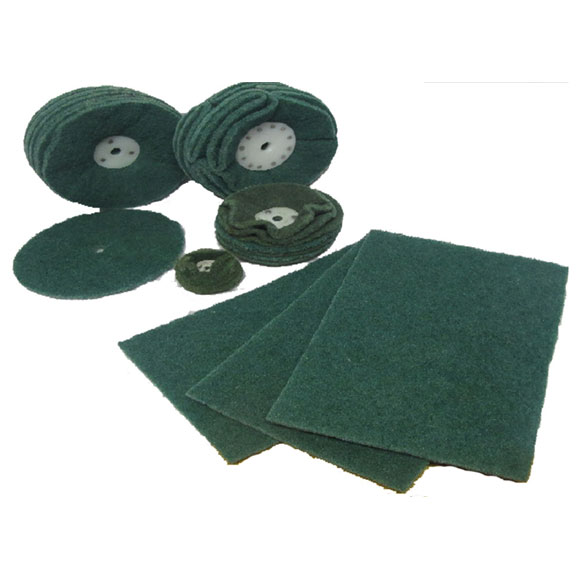
Non-Woven Polishing Mops
Consistent finishing for stainless steel, aluminium, and plastics
When a professional, repeatable surface finish is required, and consistency matters as much as quality, non-woven polishing mops are often the best tool for the job. Used extensively in Australian food equipment manufacturing, stainless steel fabrication, medical and dental instrument finishing, and plastics work, non-woven mops produce a uniform surface texture that is difficult to achieve with traditional textile mops and compound bars.
Australian Buff Company stocks a full range of non-woven mops in multiple grades, diameters, and thicknesses. This guide explains what non-woven mops are, how they work, and when to choose them over traditional polishing mops.
What are non-woven polishing mops?
Non-woven mops are constructed from synthetic nylon fibres that are randomly entangled (rather than woven) and bonded together. The fibres are impregnated with abrasive grain during manufacture, so the abrasive is distributed throughout the entire body of the mop, not just on the surface. This means that as the mop wears, fresh abrasive is continuously exposed, providing a consistent cutting and finishing action throughout the mop’s life.
The result is a mop that produces a uniform, controlled scratch pattern, unlike traditional textile mops, which can leave variable or directional marks depending on how compound is applied and how the mop wears.
Grades and applications
Australian Buff Company’s non-woven mop range includes five main grades:
Brown non-woven (fine satin finish)
Brown non-woven mops are used for cut and polish work where a clean satin finish is required. They work on all metals and are the go-to grade for achieving a fine, consistent brushed finish on stainless steel, aluminium, and brass components. Non-woven mops are sensitive to heat and must not be run too fast or with excessive pressure.
Maroon non-woven (high strength fine)
Maroon mops are a high-strength version of the fine grade, providing more aggressive cut with similar fine finishing characteristics. Suited to harder metals and heavier surface preparation work where a fine satin result is still required.
Green non-woven (coarser cut)
Green mops provide a more aggressive cutting action than brown or maroon, making them suitable for heavier surface preparation, deburring, and the earlier stages of satin finishing where more material removal is needed.
High strength medium
The high-strength medium grade sits between the fine satin (brown/maroon) and coarser (green) grades. It is well-suited to general-purpose surface preparation and finishing work across a wide range of metals.
Clean and strip
The Clean and Strip mop is designed for paint removal, coating stripping, and surface cleaning. It is more aggressive than the finishing grades and is used at the beginning of a refinishing workflow rather than as a finishing tool.
Why non-woven mops are ideal for stainless steel
One of the biggest advantages of non-woven mops in stainless steel fabrication is the consistent, directional scratch pattern they produce. Food equipment manufacturers, hospitality fitout fabricators, and architectural metalworkers often specify a particular surface finish (such as a No. 4 brushed finish) that must be uniform and repeatable across large areas and multiple components.
Traditional abrasive belts can produce a brushed finish but maintaining absolute consistency across a complex surface profile is difficult. A non-woven mop on a polishing machine or angle grinder produces a more even, controlled result across irregular surfaces, tube sections, and curved profiles.
Additionally, non-woven mops do not require compound bars, which is an advantage in environments where compound residue is undesirable, such as in food-grade fabrication where hygiene standards require surfaces to be free of chemical residue before passivation or installation.
Use in medical, dental, and plastics applications
In medical and dental instrument manufacturing, surface finish consistency is critical; not just for aesthetics but for hygiene. Rough or irregular surfaces harbour bacteria and are difficult to sterilise. Non-woven mops produce a smooth, consistent surface that meets hygiene requirements while being gentle enough to work on the precision components typical of this sector.
For plastics, non-woven mops provide a controlled finishing action that does not generate the excessive heat that can damage or deform thermoplastic surfaces. Used carefully and at the correct speed, they can restore and refine plastic surfaces without melting or smearing.
Safety note on speed
Non-woven mops are sensitive to heat and speed. They must not be run at excessive surface speeds or with heavy pressure. Always consult the AustBuff speed table when selecting the correct machine speed for your mop size, and follow all safety guidelines. Goggles, gloves, steel-cap boots, and a dust mask should always be worn when operating polishing machinery.
Frequently Asked Questions
A non-woven polishing mop is a rotating finishing wheel made from randomly entangled nylon fibres impregnated with abrasive grain. Unlike traditional textile mops, non-woven mops do not require a separate compound bar as the abrasive is built into the mop itself. They produce a consistent, uniform scratch pattern and are widely used for satin finishing, deburring, and surface preparation on metals and plastics.
No. Non-woven mops are self-contained. The abrasive is built into the nylon fibre. They are used dry, without a compound bar. This makes them particularly useful in environments where compound residue is undesirable, such as food-grade stainless steel fabrication.
For a fine satin or brushed finish on stainless steel, the Brown Non-Woven is the most commonly used grade. It produces a clean, consistent fine satin finish on all metals. For a slightly more aggressive action, the Maroon (High Strength Fine) is a good choice. If you need to remove deeper scratches or do heavier preparation before the satin finish, start with the Green mop and step down to Brown for the final pass.
Yes. Non-woven mops work well on aluminium and other non-ferrous metals. They produce a consistent finish without the loading issues that can occur with abrasive belts on aluminium. Use light pressure and appropriate speed, and be aware that non-woven mops are more heat-sensitive than textile mops.
Australian Buff Company’s non-woven mops are available in a wide range of diameters from 50mm to 200mm and in multiple thicknesses, as well as segmented mop configurations and hand pads. Custom sizes are available on request. Contact us at sales@austbuff.com.au or call (03) 9354 7380 for sizing assistance.